Mechatronics
Associate in Applied Science
Overview
Advanced automated manufacturing requires sought-after maintenance and repair professionals. MTC offers training for those skills. Industrial Maintenance and Mechatronics programs at MTC offer excellent educational opportunities for people who desire hands-on careers, enjoy troubleshooting, and are technically inclined. The programs include classroom and hands-on instruction in electrical, mechanical, hydraulic, pneumatic, and PLC technology.
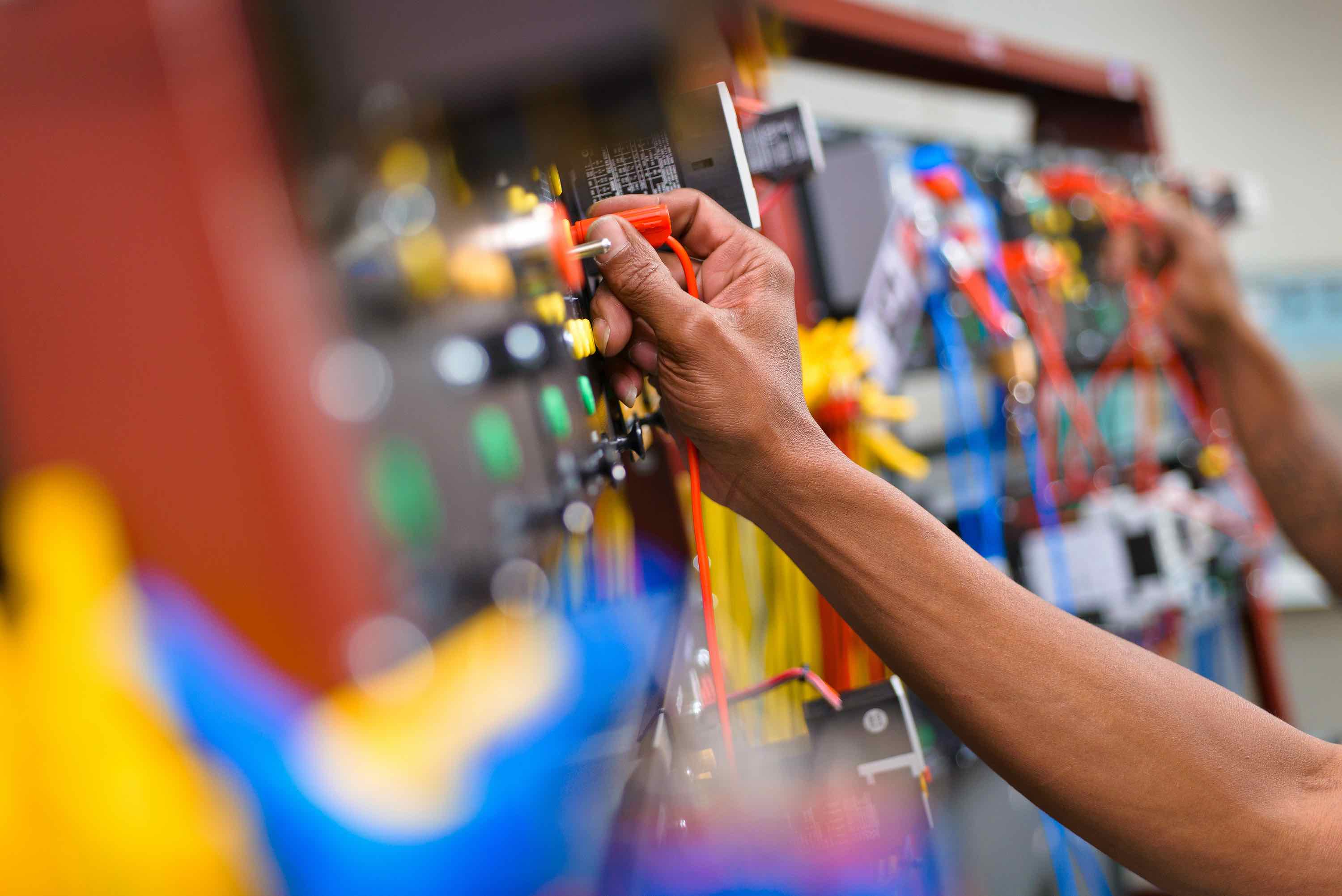
Mechatronics technicians design and maintain automated equipment. They conduct their work in laboratories, offices, or on-site at manufacturing plants. Mechatronics technicians apply their knowledge of electrical, mechanical, and computer systems to solve technical problems and maintain automated equipment. They work alongside engineers and scientists, often assisting in the research and development aspects of production. Technicians are needed in a variety of industries, including manufacturing, construction, agriculture, and aerospace.
MTC’s Mechatronics Technology program is a two-year associate degree program that prepares students to work in highly automated manufacturing environments. The program reflects the needs of local industries and includes mechanical components, industrial electricity and electronics, programmable logic controllers (PLC), hydraulics and pneumatics, as well as an introduction to process control. The program is scheduled to let students work part-time while they build multi-craft skills that lead to great jobs and career advancement.
Successful candidates usually have reasonable math skills and enjoy working with their hands to make or repair industrial equipment. Most of the graduates are entering careers in industrial maintenance so the ability to move about the shop and lift components weighing around 30 pounds is generally required
Special Note: Successful completion of some classes in this program may provide you with exemption credit and/or advanced placement into the Industrial Electrical Maintenance Technician or the Industrial Mechanical Maintenance Technician training programs at Midlands Technical College. For more information, please contact 803.732.0432.
School of Advanced Manufacturing and Skilled Trades (AMST) programs involve hands-on learning in specialized labs, so class sizes are intentionally kept small to ensure safety and individualized instruction. So, AMST programs fill quickly each semester.
Students may wish to explore Commercial Graphics and Machine Tool Technology. Commercial Graphics students bring ideas to life by creating signs, vehicle wraps, custom apparel, promotional products, and other eye-catching graphics using industry-standard equipment. Machine Tool Technology students learn to manufacture the precision components and tooling that power industries ranging from aerospace and automotive to advanced manufacturing.
Sample Program Plan and Costs
Class Delivery Methods
| On-Campus | Traditional. Classes meet on campus. |
|---|---|
| Virtual | 100% online. Meets with a live instructor and classmates on specific days, at specific times. Uses web conferencing software, like Zoom. |
| Hybrid | Some class sessions are scheduled on-campus, while others are conducted online or virtual. |
| Online | Class is conducted 100% online. Projects and assignments follow defined due dates while allowing for self-directed work on your schedule. |
*Delivery methods vary from semesters to semester. Use the filters on the Course Search to find what location or method works for you.
Full Time Schedule
| Semester | Course ID | Course Title | Classroom | Online | Hybrid | Virtual | Credits |
|---|---|---|---|---|---|---|---|
| Semester 1 (13 Credit Hours) |
COL-101 |
College Orientation College Orientation ID: COL-101 Credit Hours: 1 This course may include selected topics such as career planning, study skills, stress management, tutoring, group guidance, and other subjects to facilitate student success. |
• | • | • | 1 | |
| MAT-170 |
Algebra, Geometry and Trigonometry I Algebra, Geometry and Trigonometry I ID: MAT-170 Credit Hours: 3 This course includes the following topics: elementary algebra, geometry, trigonometry, and applications. |
• | • | 3 | |||
| MEC-102 |
Industrial Machining and Tools Industrial Machining and Tools ID: MEC-102 Credit Hours: 3 This course covers the fundamentals of machining metals by the operations of milling, drilling, and tapping along with the principles of precision measurements. Safety guidelines of operating metalworking machines and hand tools that are used in an industrial maintenance environment will be covered. |
• | 3 | ||||
| MEC-149 |
Mechanical Drawings Mechanical Drawings ID: MEC-149 Credit Hours: 3 This course covers the interpretation of various types of mechanical drawings. It includes assembly drawing, detail drawings, fluid power schematics, and other types of mechanical drawings commonly used in industry. |
• | 3 | ||||
| MEC-110 |
DC Circuits DC Circuits ID: MEC-110 Credit Hours: 3 This course is a study of direct current theory. Series, parallel, and series-parallel circuits are solved using Ohm's law and critical thinking skills. In addition to solving, circuits are constructed and tested for proper operation using various measuring instruments. |
• | 3 | ||||
| Semester 2 (12 Credit Hours) |
ENG-160 |
Technical Communications Technical Communications ID: ENG-160 Credit Hours: 3 This course is a study of various technical communications such as definitions, processes, instructions, descriptions, and technical reports. |
• | • | • | 3 | |
| MEC-111 |
AC Circuits AC Circuits ID: MEC-111 Credit Hours: 3 This course is a study of the fundamentals of alternating current theory. Circuits are constructed using various resistive, inductive, and capacitive components, and then tested for proper operation using various measuring instruments. In addition, three phase power and transformers are covered. |
• | 3 | ||||
| MEC-120 |
Sensors and Instrumentation Sensors and Instrumentation ID: MEC-120 Credit Hours: 3 This course is a study of basic industrial instruments with particular emphasis on the devices utilized to control modern manufacturing processes. Emphasis is placed on various types of sensors and how they interface with computers and controllers with machines to accomplish a task. |
3 | |||||
| MEC-103 |
Hydraulics and Pneumatics Hydraulics and Pneumatics ID: MEC-103 Credit Hours: 3 This course covers the introduction to fluid power systems and the principles of how hydraulics and pneumatics are utilized in manufacturing. In addition, the study of fluid power symbols and schematics are related to the actual working component installations. |
3 | |||||
| Semester 3 (13 Credit Hours) |
CPT-170 |
Microcomputer Applications Microcomputer Applications ID: CPT-170 Credit Hours: 3 This course introduces microcomputer applications software, including word processing, data bases, spreadsheets, graphs, and their integration. |
• | • | 3 | ||
| MEC-130 |
Motor Controls Motor Controls ID: MEC-130 Credit Hours: 4 This course is an introduction to the principles and applications of motor control circuits. A study of the various control devices and wiring used in industrial processes is also covered. |
4 | |||||
| MEC-150 |
Mechanical Systems Mechanical Systems ID: MEC-150 Credit Hours: 3 This course covers mechanical transmission devices, including various methods of how torque, HP, and motion are generated. In addition, the correct procedures for installation, removal, and maintenance as related to manufacturing equipment will be covered. |
3 | |||||
| MEC-214 |
Reliability Centered Maintenance Reliability Centered Maintenance ID: MEC-214 Credit Hours: 3 This course is the study of methods of preventive and predictive maintenance that ensures continuous improvement. This includes vibration analysis, infrared photography, and ultrasonic measuring equipment. |
3 | |||||
| Semester 4 (12 Credit Hours) |
HIS-202 |
American History: 1877 to Present American History: 1877 to Present ID: HIS-202 Credit Hours: 3 This course is a survey of u.s. history from 1877 to the present. This course includes political, social, economic, and intellectual developments during this period. |
• | • | • | 3 | |
| MEC-200 |
AC/DC Machines AC/DC Machines ID: MEC-200 Credit Hours: 3 This course is a study of applications, operations, and construction of AC and DC machines. Generators, AC/DC motors, and alternators are wired and tested for proper functionality. |
3 | |||||
| MEC-210 |
Programmable Logic Controllers I Programmable Logic Controllers I ID: MEC-210 Credit Hours: 3 This course is an introduction to programmable logic controllers with an emphasis on basic programming techniques. Basic hardware as well as a variety of input/output devices and their applications are covered. Programs are constructed, operated, and tested. |
3 | |||||
| MEC-161 |
Industrial Machines Piping Assembly and Maintenance Industrial Machines Piping Assembly and Maintenance ID: MEC-161 Credit Hours: 3 This course covers assembly, maintenance, and troubleshooting practices for piping systems used in industrial manufacturing facilities. This course implement these practices on various types of piping to include rigid, copper, PVC, flexible rubber, and plastic tubing. |
3 | |||||
| Semester 5 (12 Credit Hours) |
PSY-201 |
General Psychology General Psychology ID: PSY-201 Credit Hours: 3 This course includes the following topics and concepts in the science of behavior: scientific method, biological bases for behavior, perception, motivation, learning memory, development, personality, abnormal behavior, therapeutic techniques, and social psychology. |
• | • | • | • | 3 |
| MEC-212 |
Robotics and Automation Robotics and Automation ID: MEC-212 Credit Hours: 3 This course includes programming and testing robotic equipment used in automation with a concentration on connecting, assembling, and automating manufacturing processes. |
3 | |||||
| MEC-211 |
Programmable Logic Controllers II Programmable Logic Controllers II ID: MEC-211 Credit Hours: 3 This course covers the application of programmable logic controller theories and operation procedures. Topics such as interfacing data manipulation and report generation are covered. Programmable controller projects are constructed, operated, and tested. |
3 | |||||
| MEC-203 |
Industrial Process Systems Wiring Industrial Process Systems Wiring ID: MEC-203 Credit Hours: 3 This course covers the code and techniques used specifically for electrical wiring of industrial process machines and components |
3 | |||||
| Total Credit Hours | 62 | ||||||
| Estimated Cost Financial Aid |
$12,772.00 Not including fees and equipment |
||||||
What’s next after I complete this program?
Further Your Education
Continue Education toward a bachelor’s degree in Advanced Manufacturing, Engineering, or Business.